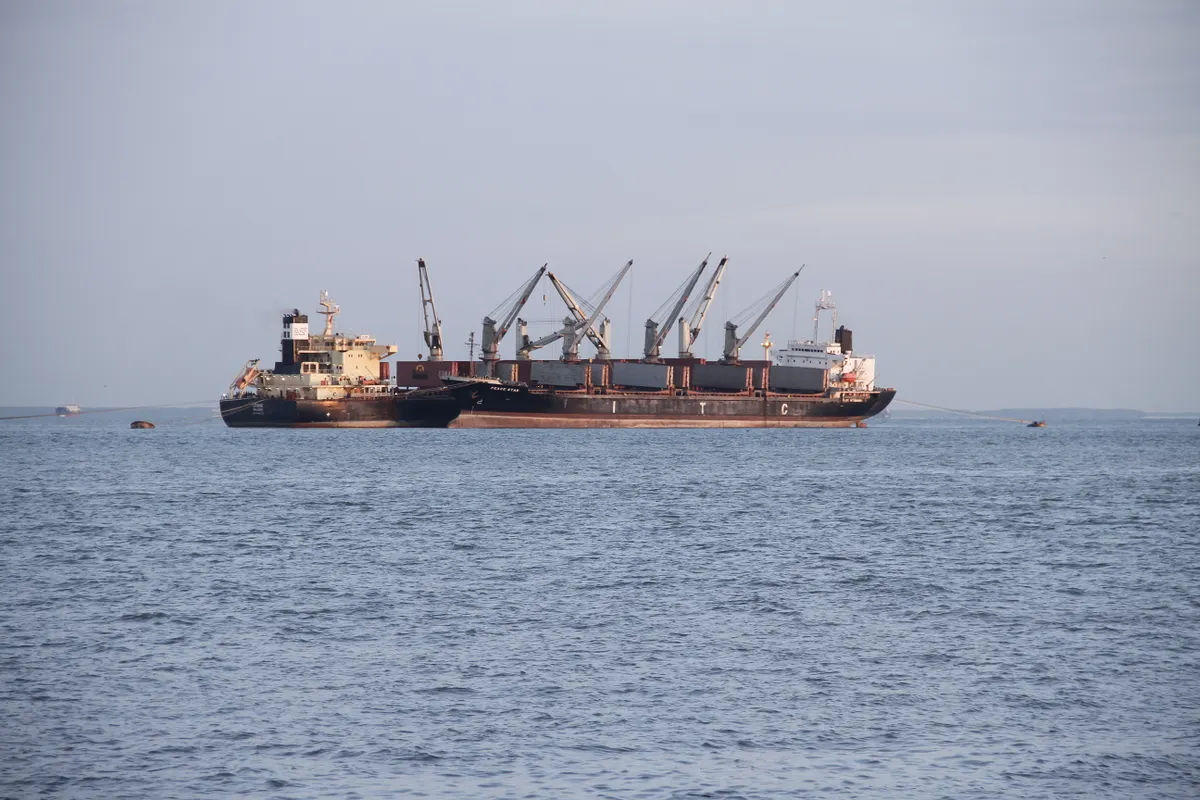
A Hormuz ship attack kills one crew member and has renewed fears over safe passage through the world’s most strategically watched waterway, even as President Donald Trump declared the strait ‘open and operating.’ The attack comes amid a fragile and deteriorating situation since the expiry of a US-Iran agreement meant to restore normal shipping.
The United Kingdom Maritime Trade Operations Centre (UKMTO) said a projectile struck a cargo vessel as it exited the strait, damaging its engine room. Oman’s Coast Guard moved in to assist the remaining crew, and no environmental damage has been reported. The ship was travelling southbound and was less than one nautical mile from the Omani coast at the time of the attack, according to the Joint Maritime Information Center.
Trump insists strait is clear, but questions linger
Trump posted on Truth Social, hours after the attack, that the Hormuz Strait is ‘open and operating’ and that ‘all water mines have been removed or detonated.’ When CNBC asked US Central Command to confirm whether all mines had been cleared, it referred the inquiry to the White House.
US Energy Secretary Chris Wright said last week that oil exports through Hormuz had reached a seven-day average of nearly 9 million barrels per day, a figure higher than most estimates from independent firms. Wright attributed the discrepancy to ships moving covertly through the waterway, which he said causes private businesses to undercount the number of vessels leaving the strait.
The memorandum of understanding (MOU) signed by Washington and Tehran on 17 June to reopen Hormuz expired on Monday without a final deal being reached. Iran’s parliamentary speaker, Mohammad Bagher Ghalibaf, said Tuesday that Hormuz will remain closed until the US meets its commitments under the MOU, according to the state news agency Tasnim. Trump, for his part, said the US is not holding any talks with Iran.
A rising toll on seafarers and commercial shipping
The latest attack adds to a grim toll for those working on commercial vessels in the region. At least 17 mariners have been killed in 65 attacks on commercial vessels since the conflict began on 28 February, according to the International Maritime Organization, a United Nations agency.
Among those incidents, the Liberian-flagged bulk carrier Minoan Dignity came under attack while transiting the Strait of Hormuz on 17 August 2026, resulting in the death of a seafarer, according to Seatrade Maritime. In a separate attack reported by AP News, the United Arab Emirates’ Defense Ministry said Iran launched two cruise missiles at the tankers Mombasa and Al Bahiyah, killing one mariner and wounding eight others.
Iran has repeatedly targeted ships taking the US-protected southern route through Hormuz in an effort to close that corridor, insisting instead that vessels use a northern route through its own territorial waters.
The broader military context is set out by the Wikipedia article on the 2026 Strait of Hormuz crisis, which records that the United States launched strikes against Iranian missile batteries, air defence systems, and Islamic Revolutionary Guard Corps fast attack boats at multiple locations around the strait, including military targets on Qeshm Island. Those strikes killed Iranian navy lieutenant Hamidreza Dehghani at the southern port of Jask.
Oil flows have recovered, but passage remains dangerous
Despite the violence, crude oil exports through Hormuz have been climbing under US military protection. Crude exports rose to about 5 million barrels per day in July, up from about 4 million barrels per day in June and 1.6 million barrels per day in May, according to Michelle Wiese Bockmann, maritime intelligence analyst at Windward. Before the conflict began, roughly 20 million barrels per day of crude and products passed through the strait, representing about a fifth of the world’s oil consumption.
‘Transits have scaled up very quickly against a backdrop of extreme risk,’ Bockmann said.
Ship traffic data, however, tells a more cautious story about day-to-day activity. The five-day average for transits through Hormuz stands at about 10, according to a CNBC analysis of data from trade intelligence firm Kpler, the lowest level since 11 May. There were 10 crossings on Monday and just two on Sunday. Before the conflict, about 130 vessels crossed Hormuz daily.
Iran and the US remain at odds over the terms of the expired MOU, with Tehran and Washington offering conflicting interpretations of what the agreement required. Ghalibaf’s statement that the strait will stay closed until the US honours its commitments leaves the next move firmly in the diplomatic arena.