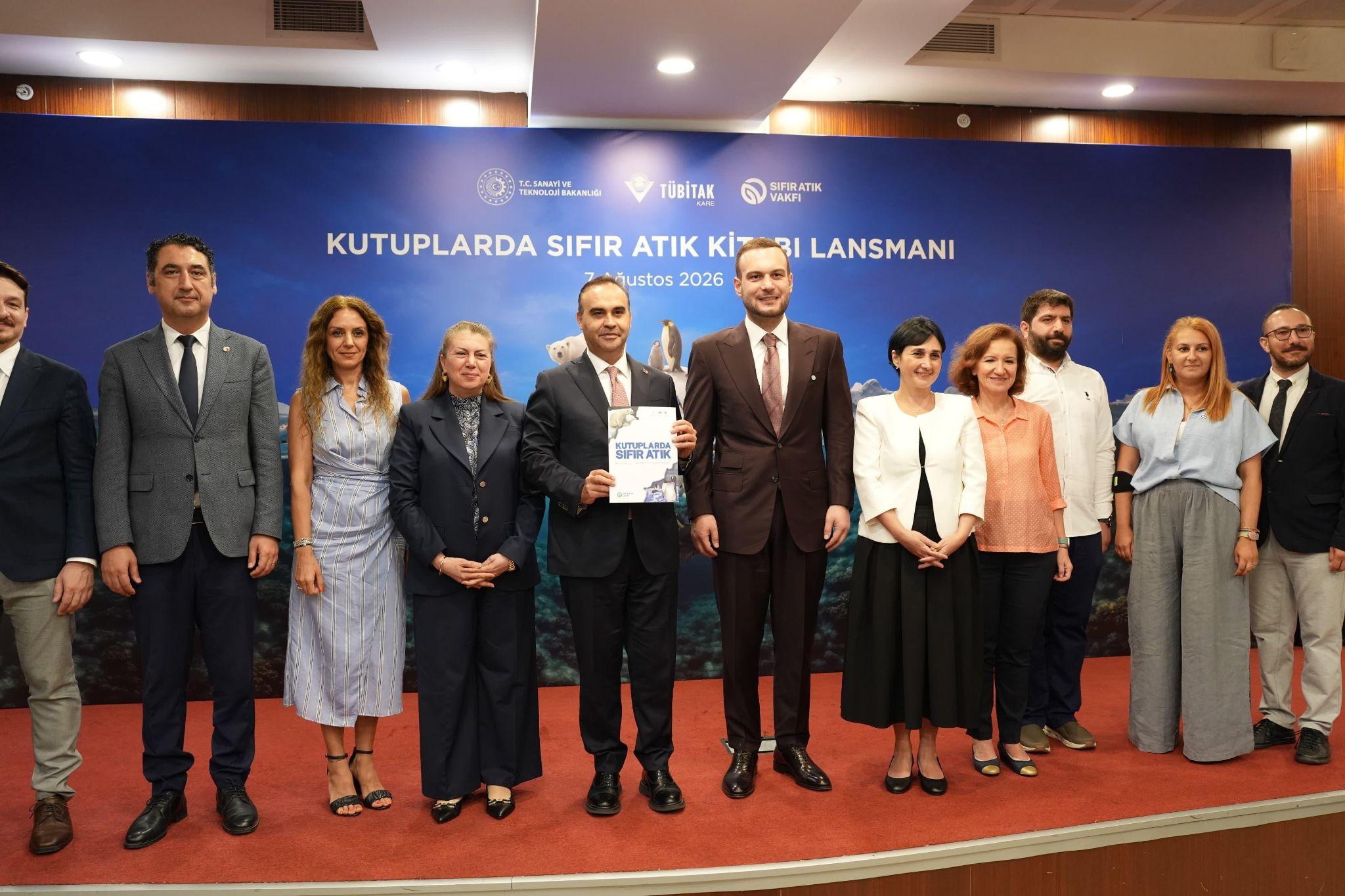
The Arctic and Antarctic are home to some of the planet’s most fragile ecosystems, from ice-dependent seabirds to the marine life that relies on stable polar conditions. A new book published this month puts these environments at the heart of a wider conversation about how scientific research itself can be conducted with less waste and a lighter environmental footprint, just as Türkiye prepares to host COP31.
The Zero Waste Foundation launched “Zero Waste in the Polar Regions” on 7 August, a book prepared together with the TÜBİTAK (Scientific and Technological Research Council of Türkiye) Polar Research Institute. Ten days later, the Foundation signed a cooperation protocol with London Climate Action Week (LCAW), extending its work on zero waste and the circular economy into an international climate network based in London.
What happens to waste at the ends of the earth
The book examines climate change, environmental pollution and zero waste practices in the Arctic and Antarctic through scientific data, bringing together 18 articles from scientists who have carried out polar research. The contributions cover the scientific, technical, administrative and communication dimensions of applying zero waste principles in some of the world’s most remote and ecologically sensitive regions.
Rather than focusing narrowly on how waste is collected once it is produced, the work looks at how scientific expeditions are planned from the outset, how materials and resources are used in the field, and how energy, water and logistics are managed throughout polar research activity. The underlying aim is to reduce waste before it is generated at all, and to limit the environmental footprint left behind by research itself in landscapes where recovery from disturbance can be exceptionally slow.
The publication frames the polar regions as critical indicators of global climate change, noting that environmental shifts occurring there carry consequences that extend far beyond the Arctic and Antarctic themselves. That framing gives the research a relevance that reaches well past the specific locations where the work was carried out, touching on the wider web of species and ecosystems connected to polar stability.
Mehmet Fatih Kacır, Minister of Industry and Technology of Türkiye, said the book brought together two national initiatives that both began in 2017. “The Zero Waste initiative launched under the leadership of H.E. Emine Erdoğan has grown step by step from a national initiative into a global one,” he added.
“At the same time, we began organising scientific expeditions to Antarctica and the Arctic under the auspices of the President of the Republic of Türkiye, enabling Turkish scientists to strengthen the country’s presence in polar research. Through this book, these two initiatives have come together.”
The study also reflects the broader zero waste vision advanced by H.E. Emine Erdoğan, Founder of the Zero Waste Movement, Chair of the UN High-Level Advisory Board on Zero Waste and Honorary President of the Zero Waste Foundation, whose work has helped shape how resource efficiency is discussed on both national and international platforms.
A London link for polar and climate cooperation
The second development came on 17 August, when the Zero Waste Foundation and London Climate Action Week signed a protocol establishing an institutional partnership between the two bodies. The agreement is aimed at strengthening knowledge exchange, collaborative initiatives and international dialogue around zero waste and the circular economy, connecting Türkiye’s polar and resource efficiency research with a much wider international audience.
The protocol was signed by Samed Ağırbaş, President of the Zero Waste Foundation and COP31 High-Level Climate Champion, and Climate Action Founder and CEO Nick Henry. Ağırbaş said the agreement opened the door to further joint work. “After this cooperation protocol, I hope we will carry out strong work and organize joint events at COP31 and London Climate Action Week,” he said.
London Climate Action Week brings together participants from government, cities, business, finance, academia, civil society and local communities, giving the partnership a broad platform. For an audience concerned with the natural world, the significance lies in how research practices affecting polar wildlife habitats are now being folded into a much larger international discussion about climate action, rather than being treated as a niche or isolated concern.
Why COP31 raises the stakes for polar environments
Türkiye’s role as host of COP31 provides the wider diplomatic backdrop against which both developments sit, though the immediate focus of the Foundation’s work remains practical exchange with the LCAW network rather than the summit itself. The polar regions, as environments highly sensitive to even small climatic shifts, offer a clear illustration of why resource efficiency in scientific research matters well beyond the immediate footprint of any single expedition.
By linking scientific research, resource efficiency and circular economy thinking to international climate action, the Foundation’s recent work resists reducing the zero waste concept to recycling or waste management alone. Instead, it positions the careful use of materials, energy, water and logistics in fragile environments like the Arctic and Antarctic as part of a much larger effort to understand and respond to global environmental change, one in which the health of polar ecosystems continues to serve as an early signal for changes affecting wildlife and habitats far beyond the poles.