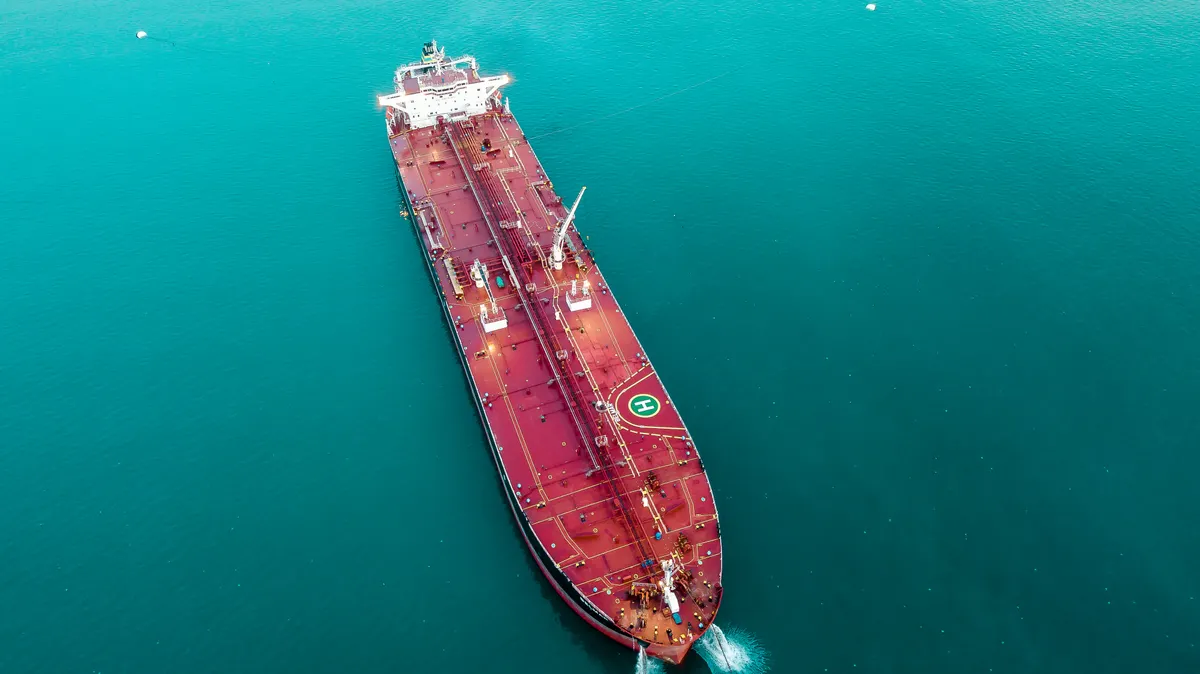
A Strait of Hormuz tanker attack has thrown fresh scrutiny on President Donald Trump’s assurances that the waterway is safe for shipping, after an oil tanker was struck by an unidentified projectile off the Omani coast, the UK Maritime Trade Operations (UKMTO) agency confirmed.
The UKMTO said the incident was reported on Tuesday. A fire broke out on the vessel but was subsequently extinguished, all crew members were reported safe, and an investigation is under way. The strike is the latest in a run of sporadic attacks that have kept ships away from one of the world’s most important energy corridors, through which a significant share of global oil supply passes.
Ship traffic through the strait has collapsed
The scale of the disruption is stark. According to shipping data firm Kpler, only five vessels made confirmed crossings on Tuesday, down from seven the previous day. Before the war, the strait saw more than 130 vessels a day. All five of Tuesday’s crossings used the unilateral route that Iran has designated for shipping, Kpler said. The previous week, an attack on a cargo ship transiting the waterway killed a crew member.
Traffic has trended lower throughout this week and remains far below pre-war levels, even as the U.S. has sought to help escort vessels along the Omani side of the strait. The U.S. military has maintained a naval blockade against Iranian ships at the chokepoint and has used a southern Omani lane to escort oil tankers in and out of the Gulf.
On Wednesday, Trump told reporters that Hormuz had been fully cleared of mines, describing it as ‘a functioning strait.’ ‘Yes, every once in a while there will be a drone or a rocket or something shot, but it is a very functioning strait. A lot of oil is pouring out,’ he said. U.S. allies, however, are sceptical that Iran’s mines have been fully cleared, Bloomberg reported, casting doubt on that assessment.
Strait of Hormuz tanker attack follows partial mine clearance
What the U.S. Navy has cleared is the Traffic Separation Scheme (TSS), the median lane of the strait positioned between Oman and Iran, according to Axios. That is a more limited claim than a complete clearance of the waterway, and it helps explain why allied governments remain cautious about declaring Hormuz fully open.
The groundwork for that clearance effort stretches back years. According to Fox News, elements of large-scale mine clearance in the strait have been practised through recurring NAVCENT mine-countermeasure exercises dating to 2012, meaning the capability deployed in recent weeks was built over more than a decade of preparation.
Separately, Iran and Oman have agreed on a temporary maritime corridor intended to restore safer passage through the strait. Iran’s Deputy Foreign Minister Kazem Gharibabadi, however, warned that the waterway will not fully reopen until the U.S. fulfils its commitments under an interim peace deal framework signed in June, which has since lapsed. That condition ties any reopening directly to the state of U.S.-Iran relations, which have deteriorated sharply.
Washington escalates economic pressure on Tehran
This week, the Trump administration launched what it described as an ‘economic onslaught’ against Iran’s financial connections around the world, increasing pressure on countries and entities that maintain economic ties with Tehran. That escalation has damaged prospects for renewed peace talks between Washington and Tehran.
In an interview with Al Jazeera on Wednesday, Trump said he has ‘no time schedule’ for when he expects to resume talks with Iran to end the six-month war. When asked whether economic pressure was more effective than military strikes, Trump said, ‘I think they are both effective.’
Iran’s Foreign Minister Abbas Araghchi responded to the sanctions campaign with a diplomatic appeal, calling on the UN and its member governments to condemn what he described as U.S. ‘economic terrorism.’ Araghchi argued the UN bears ‘legal and moral responsibility’ to denounce the campaign as ‘illegal and criminal.’
With the TSS cleared but wider mine concerns unresolved, and Tuesday’s tanker strike still under investigation, the UKMTO says its monitoring of the strait continues.