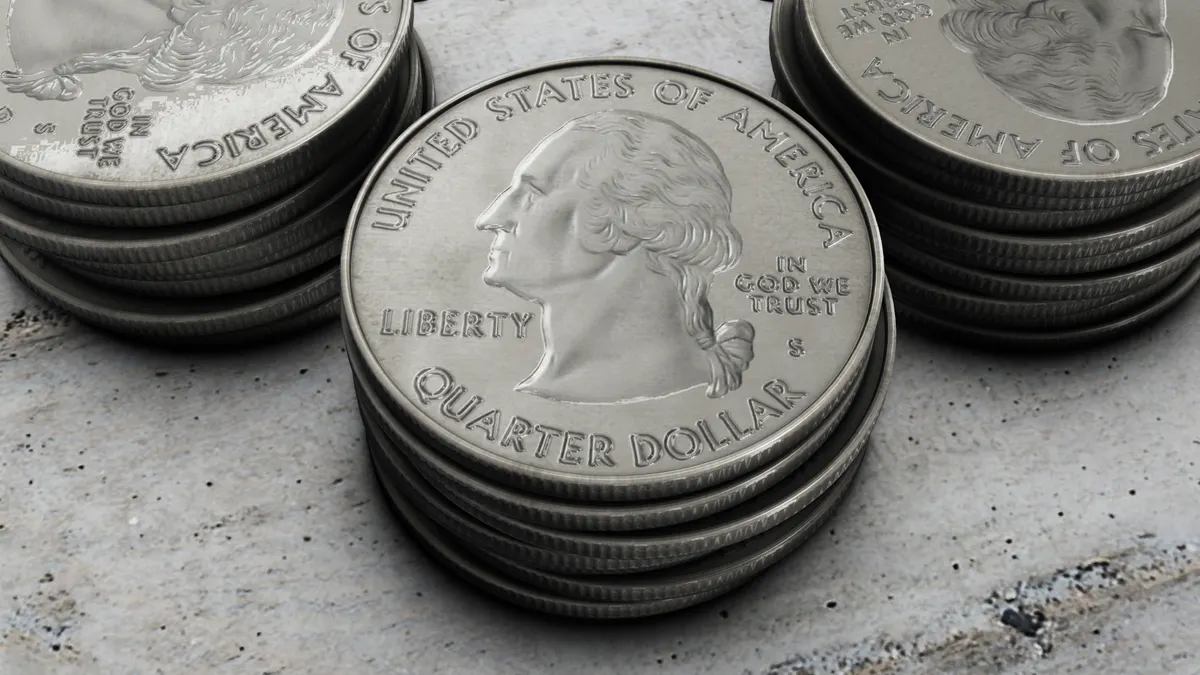
The Trump dollar coin sell-out came within hours of the El Paso Times reporting the new $1 coin going on sale, as the US Mint launched a commemorative piece bearing President Donald Trump’s portrait to mark America’s 250th anniversary. The coins were listed as “not currently in stock” on the Mint’s website within hours of going on sale on Wednesday.
The coins carry Trump’s portrait alongside the inscriptions “LIBERTY,” “IN GOD WE TRUST” and “1776 ~ 2026,” tying the piece directly to the country’s semiquincentennial. The US Mint described them as created to celebrate “this historic national milestone” with a “once-in-a-generation anniversary design destined to become a standout addition to modern collections.”
What the Trump dollar coin sell-out means for buyers
The coins were priced at $61 (£45) for a roll of 25 and $154.50 for a bag of 100. Alongside the Mint’s website, they were also available through vending machines at the US Mint store in Washington DC. The BBC said it had contacted the US Mint, the Treasury and the White House for further details.
Although the US Mint confirmed the coins are not being put into general circulation, they may still be used as legal tender. Despite their golden colour, they contain no actual gold. According to the Mint, the coins are 88.5% copper, with the remainder made up of zinc, manganese and nickel.
Federal law ordinarily prohibits a living president from appearing on US currency. The Mint got around that restriction by using a design clause written into the legislation governing America’s 250th anniversary celebrations.
A rare precedent, and a wider pattern of firsts
The last time a living president appeared on a US coin was a century ago. According to CNN, the only previous instance was in 1926, when President Calvin Coolidge was featured on a half-dollar coin issued for the 150th anniversary of the signing of the Declaration of Independence. Trump’s appearance on the new $1 coin makes him only the second sitting president in American history to be depicted on US coinage.
The Trump administration has also pointed to the Circulating Collectible Coin Redesign Act of 2020, passed during Trump’s first term, as further legal grounding. That statute prohibits portraits of living people on the reverse (tails) side of coins, but does not explicitly cover the obverse (heads) side, which is where Trump’s likeness appears on the new piece.
The groundwork for the coin was laid some time before Wednesday’s launch. TIME reports that Treasury Secretary Scott Bessent shared a photographic rendering of the commemorative coin on social media on 15 July 2026, giving the public an early look at the design before it went on sale.
Bessent had also, in May, announced that his department was planning to issue a new $250 bill carrying a portrait of President Trump. When making that announcement, Bessent pointed to the Coolidge half-dollar as evidence that a living president had previously appeared on American currency, establishing a precedent for the move.
The coin is far from the only way the administration has sought to place Trump’s image on official American currency and documents. In March, the Treasury announced that US paper money would soon carry Trump’s signature, itself described as a first for a sitting president.
The Trump dollar coin sell-out on launch day means those who missed the initial window will need to monitor the Mint’s website for restocked inventory, or look to the Washington DC store, where the coins were being sold through vending machines at the time of the launch.