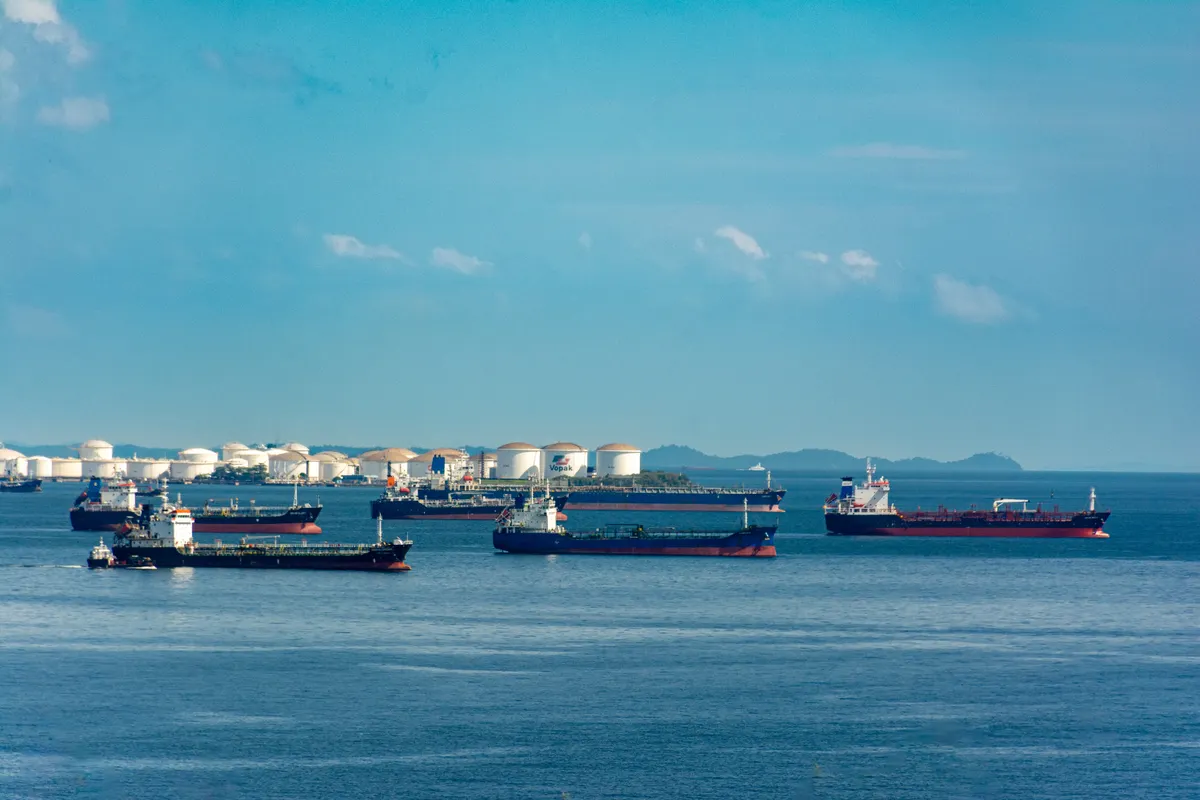
Oil prices pushed higher on Thursday, with Brent crude above $101 a barrel, after the United States military destroyed five Iranian oil tankers earlier in the week and Iran’s forces issued fresh warnings to shipping in the Gulf region. The moves deepened concerns that the ongoing conflict between Washington and Tehran could choke off a meaningful share of global oil supply.
Brent futures for November delivery rose 0.62% to $101.84 a barrel, while US West Texas Intermediate (WTI) futures for October gained 1.01% to $96.06 a barrel. The price jump follows a period of relative calm in oil markets, making the scale of this week’s moves all the more abrupt for traders and buyers alike.
The tanker strikes that sent Brent crude above $101
On Tuesday, the US military destroyed five Iranian crude oil tankers in retaliation for attempted attacks on an American warship. According to US Central Command (CENTCOM), the vessels were the M/T Kaviz, M/T Charminar, M/T Horizon 1, and M/T Riesco in the Gulf of Oman, and the M/T Derya near Kharg Island. CENTCOM stated that the American warship successfully evaded the Iranian attack and that no US personnel were harmed.
Reuters reported that Brent crude breached $100 a barrel for the first time since July in the immediate aftermath of the strikes, before extending those gains further into Thursday’s session. The $100 threshold carries weight for oil markets because prices at that level feed through quickly into fuel costs for businesses and households worldwide.
Iran warns shipping near Kuwait and Bahrain
The situation has since broadened beyond the tanker strikes themselves. Iran’s Revolutionary Guard Navy warned crews of oil tankers near ports in Kuwait and Bahrain to immediately leave their vessels, stating the ships could be targeted in retaliation for the US attacks on Iranian tankers, according to NPR. That warning extended the zone of risk well beyond Iranian waters and raised the prospect of disruption to vessels serving some of the Gulf’s busiest export terminals.
Andrei Constantin, commercial director and trading adviser at TFP Software FZCO, said the physical oil market may tighten further because of a decline in transit volumes, broader escalation, or threats to energy infrastructure, each of which could extend the upward move in prices.
David Morrison, senior market analyst at Trade Nation, noted how quickly prices had recovered lost ground: ‘WTI has completely unwound its selloff between early June and July, while Brent prices are now well above those seen in early June.’
Goldman Sachs flags risk of $120 oil
The conflict between the US and Iran is now in its seventh month, and the stakes in oil markets are rising with it. Daan Struyven, co-head of global commodities research at Goldman Sachs, said in an interview on CNBC’s Squawk Box Asia that the escalating conflict is raising the risk of oil prices surging above $120 a barrel as attacks on shipping intensify.
A move to those levels would represent a sharp additional increase from current prices and would have wide consequences for inflation and consumer costs in oil-importing economies, including the United Kingdom. Petrol and diesel prices tend to track crude benchmarks with a short lag, meaning sustained prices above $100 are quickly felt at the forecourt.
Meanwhile, the Wall Street Journal reported that US President Donald Trump’s top White House advisers have raised privately with him the prospect that the Iran conflict could drag on through the remainder of his term. If that assessment proves correct, the pressure on oil supply routes through the Gulf could persist well beyond the current spike rather than resolving quickly.
The warning from Iran’s Revolutionary Guard Navy to tanker crews near Kuwait and Bahrain will be the immediate focus for markets in the coming days, given how directly it threatens the flow of crude from two of the region’s key shipping hubs.