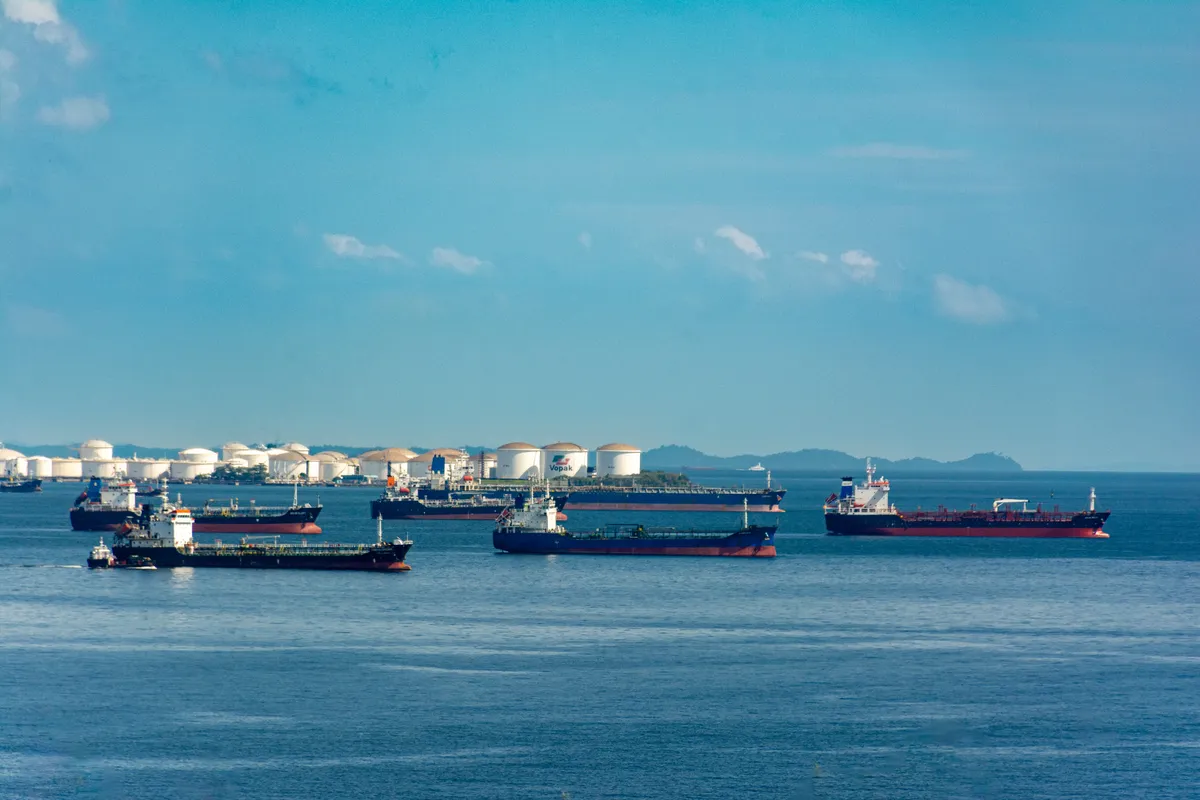
Iran’s Strait of Hormuz closure has become the sharpest flashpoint in a rapidly escalating military confrontation, as US strikes on Iranian targets prompted Kuwait to shut its airspace, Bahrain to scramble its air defences, and Israel’s Home Front Command to warn northern communities of launches from Lebanon.
Kuwait and Bahrain Under Fire
Kuwait temporarily closed its airspace on Thursday, citing ‘Iranian aggressions’ after intercepting what it described as ‘hostile aerial targets.’ Iran’s state-run Tasnim News Agency reported that Iran ‘struck and destroyed eighteen important targets’ belonging to US forces at Kuwait’s Ali Salem and Ahmad al-Jaber air bases, as well as the Sheikh Issa air base in Bahrain. Kuwait reopened its airspace after several hours.
In Bahrain, the media adviser to the king said the country’s air defence systems had intercepted and destroyed ‘Iranian aerial attacks.’ Earlier in the day, Bahrain’s interior ministry had urged civilians to head to a safe place. Israel’s Home Front Command also warned residents of several communities in northern Israel of launches from Lebanon.
The confrontation follows US strikes against multiple targets in Iran, carried out at President Donald Trump’s direction in response to what the White House called ‘Iran’s unwarranted and continued aggression.’ US Central Command said the strikes were completed at 9:04 p.m. ET on Wednesday, hitting Iranian military surveillance capabilities, communication systems, and air defence sites. US forces also fired on Iranian targets that ‘posed a threat to US forces and international commercial ships transiting regional waters.’
Iran Strait of Hormuz Closure: A Direct Threat to Shipping
The most consequential development for global trade came when Iran’s Islamic Revolutionary Guard Corps (IRGC) formally declared the closure of the Strait of Hormuz, the narrow passage between Iran and the United Arab Emirates that connects the Persian Gulf with the Gulf of Oman and the Arabian Sea, according to Riviera. Senior IRGC official Ebrahim Jabari stated plainly: ‘The strait is closed.’
The closure would remain in force until the US blockade is lifted, Iran’s Revolutionary Guard navy said, warning that ‘no vessel should make any movement from its anchorage in the Persian Gulf and the Sea of Oman, and approaching the Strait of Hormuz will be considered as cooperation with the enemy’ and be targeted, AP News reported. Iranian state media also reported earlier that Iran had targeted US ships in the Strait of Hormuz with missiles and drones.
Reuters separately reported that Iran’s top military command had completely closed the strait, warning that any vessel attempting to cross would be targeted. The Strait of Hormuz is one of the world’s most critical chokepoints for oil and gas shipments, and its closure carries immediate consequences for energy markets worldwide.
Trump Signals Possible Pause, Markets React
Trump told Fox News that he had spoken directly with Iranian officials, who he said asked him to stop the strikes. He said the bombing would stop shortly and that Israel was not involved, though he left the door open for further military action. When asked whether a ceasefire was over, Trump reportedly said it was ‘the most violated ceasefire in history.’
Earlier on Wednesday, Trump had made clear his intentions at a White House signing event. ‘We hit them hard yesterday, and we’re going to hit them hard again today,’ he said. ‘We’re going to be attacking them and attacking them very hard.’ He also called on Iran to ‘sign the deal,’ saying the US wants an agreement ‘that’s meaningful and works.’
Iran’s response was combative. Ebrahim Azizi, head of the national security commission in Iran’s parliament, wrote on X that ‘this time, the war won’t be limited to the region.’ Trump had previously warned on Truth Social that Iran had taken too long to negotiate and would ‘pay the price,’ adding that ‘Iran’s Military is a complete and total mess’ and that ‘much of it, like their Navy and Air Force, doesn’t even exist anymore.’
Financial markets moved sharply. US crude climbed nearly 2% to $89.72 per barrel and Brent rose 1.3% to $92.74, while the Dow Jones Industrial Average dropped more than 600 points following Trump’s comments. Claudio Galimberti, chief economist at Rystad Energy, told CNBC earlier in the week that oil could hit $150 per barrel within the next couple of months if fighting in the Middle East continues, as inventories are now at very low levels.
Trump disputed that trajectory. ‘It’s a military operation,’ he said, repeating his assertion that oil prices will return to the levels they were at before the war began in February. ‘When it’s over, you will see oil drop to where it was before.’ The IRGC’s formal closure of the Strait of Hormuz, with its explicit threat to set ships ablaze if they attempt to pass, will be the immediate test of whether that prediction holds.