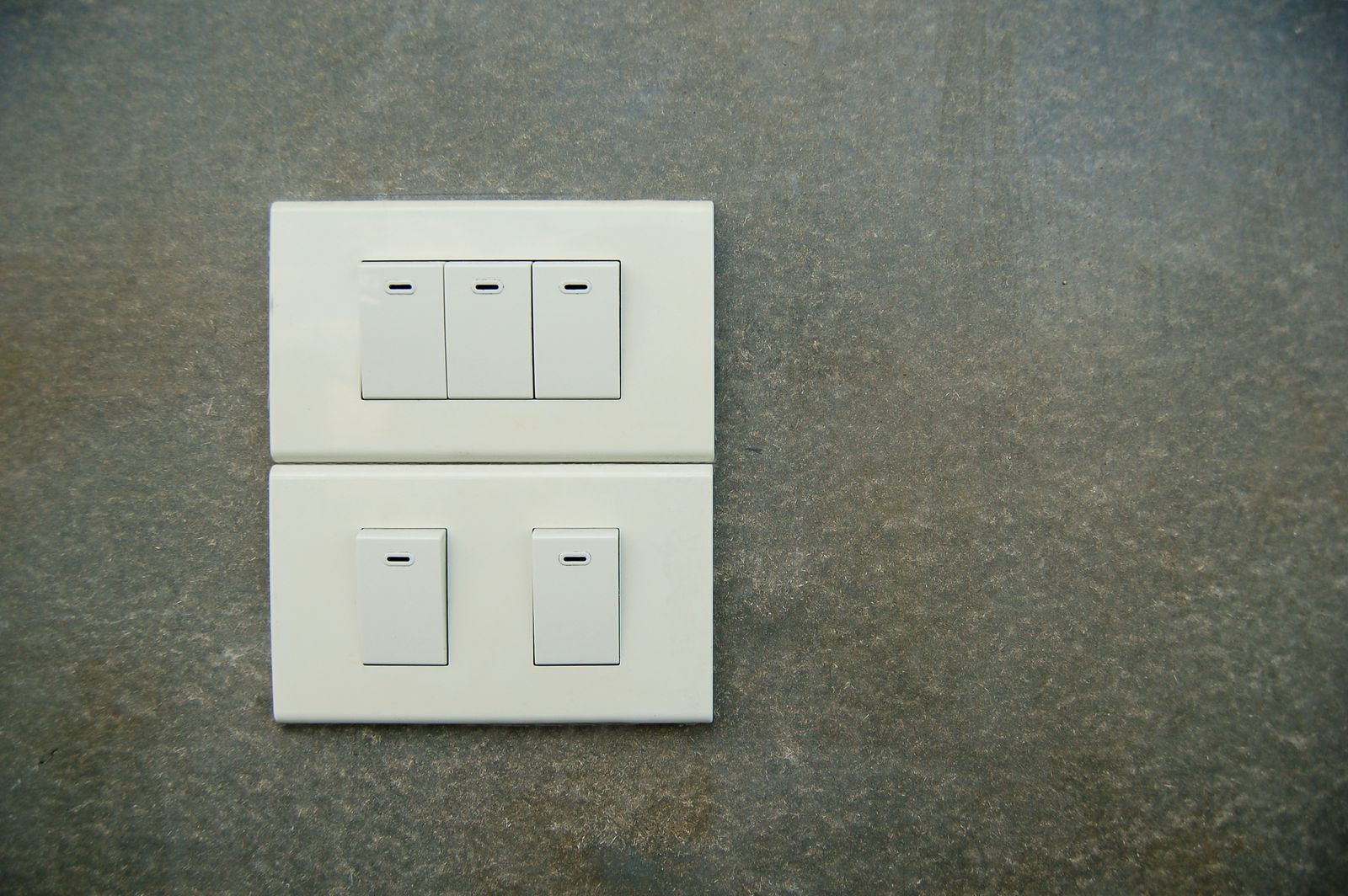
Smart lighting is often presented as one of the simplest ways to upgrade a home. Change the switch, connect it to an app and suddenly the lights can be controlled from a phone, included in routines or operated by voice.
For plenty of households, it can be relatively straightforward. For others, removing the existing light switch reveals a problem that wasn’t obvious beforehand: there may be no neutral conductor at the switch position.
It is a common source of confusion when people start looking at smart lighting, particularly in older properties, because a conventional light switch and a smart light switch don’t necessarily have the same wiring requirements.
That doesn’t mean an older house can’t have smart lighting. It does mean homeowners need to understand what wiring is actually present before choosing the switch.
Why isn’t there always a neutral wire behind a light switch?
A traditional mechanical light switch has a fairly simple job. It opens or closes the circuit controlling the light.
Because of the way many lighting circuits have historically been wired, the neutral conductor may be present at the light fitting or another point in the circuit rather than at the wall switch.
That isn’t necessarily a fault. It can simply be a consequence of how the lighting circuit was designed.
The issue arises when you replace a conventional switch with an electronic smart switch.
Unlike a basic mechanical switch, a smart switch contains electronics. Depending on the product, those electronics may need a permanent supply so that functions such as wireless communication and remote control remain available even when the light itself is switched off.
Many smart switches achieve this using both a permanent live and neutral connection at the switch.
If the existing wiring doesn’t provide a neutral there, that particular type of smart switch cannot simply be connected in place of the old one.
It isn’t simply a case of finding a blue wire
This is where DIY assumptions can become dangerous.
Modern UK wiring uses blue for neutral conductors, but you should never treat a wire’s colour as proof of its function.
Existing homes may contain wiring installed under previous colour conventions, alterations carried out at different times, or conductors that have been appropriately identified for a purpose other than their base insulation colour.
A conductor within a switch box therefore shouldn’t be assumed to be neutral simply because of its appearance.
If you’re unsure about the wiring, have a competent electrician identify and test it rather than experimenting with connections.
Why do some smart switches work without a neutral?
The absence of a neutral at the switch position doesn’t automatically rule out smart lighting.
Some smart switches are designed for installations where a neutral isn’t available at the switch.
Rather than relying on the same supply arrangement as a conventional neutral-required smart switch, these products use a different circuit arrangement. Depending on the switch and lighting load, installation may also require an additional component, such as a bypass or capacitor.
That is why the phrase “no neutral required” matters when comparing products.
A homeowner with this type of wiring needs a switch designed for that situation, not just any WiFi-enabled switch.
Specialist suppliers such as WiFi Smart Home offer no-neutral smart light switches intended for appropriate installations where a neutral conductor isn’t available at the switch position.
As with any electrical accessory, however, you still need to check compatibility against the manufacturer’s requirements and the existing installation.
Older doesn’t automatically mean unsuitable
It would be misleading to suggest that every Victorian terrace, 1930s semi or post-war house has the same wiring.
The age of the building only tells part of the story.
A 100-year-old property may have been completely rewired relatively recently, while a much newer house could retain an installation that has been altered several times.
Two neighbouring properties built at exactly the same time may no longer have identical electrical installations.
The only reliable approach is to assess the wiring that is actually present.
This is particularly important because a lack of a neutral at a switch is not the only issue you may encounter in an older electrical installation.
Electrical Safety First notes that, in homes built before 1966, the Wiring Regulations in force at the time did not require a protective conductor to be taken to every lighting point and related accessory as expected today.
A protective conductor and a neutral conductor perform different functions, so the two issues shouldn’t be confused. The point is that older lighting circuits can differ from modern installations in more than one respect.
Does an old electrical installation have to be rewired?
Not simply because it is old.
Current electrical standards have developed considerably over time, but an existing installation that doesn’t meet every detail of today’s requirements doesn’t automatically mean it is unsafe or needs complete replacement.
Electrical Safety First’s guidance on BS 7671 makes this distinction clear: existing installations installed to earlier editions of the Wiring Regulations may not comply with the current edition in every respect, but that alone does not necessarily make them unsafe for continued use.
What matters is the installation’s condition and suitability, and whether any proposed alteration can be carried out safely.
That is another reason replacing a light switch shouldn’t become an exercise in guessing what is behind the wall.
What should homeowners check before buying?
The first question is whether the smart switch being considered requires a neutral connection.
If it does, the next question is whether a suitable neutral is actually available at the intended switch position.
Other product-specific requirements matter too. These can include the type of lighting load, minimum or maximum loads, whether dimming is required, the physical space available in the back box and any additional components specified by the manufacturer.
Smart-home compatibility is another consideration. A switch being electrically suitable doesn’t necessarily mean it supports the particular platform or control system the homeowner wants to use.
Checking these details before purchasing is considerably easier than discovering an incompatibility after the existing switch has been removed.
Electrical work isn’t the place for trial and error
Smart switches sit at the intersection of consumer technology and fixed electrical wiring, and that can make them look deceptively simple.
The app may be straightforward. The wiring is still mains electricity.
Electrical Safety First advises consumers not to carry out electrical repairs themselves and recommends using appropriately registered electricians for electrical work. Its technical guidance also stresses that manufacturers’ instructions must be considered when selecting and installing electrical equipment.
If you don’t know the wiring arrangement, the sensible course is to have it checked before choosing a replacement switch.
An electrician can confirm which conductors are present, assess the existing circuit, and determine whether the proposed equipment is appropriate.
An older house can still become a smart home
The absence of a neutral conductor at a light switch is a compatibility issue, not the end of the smart-home project.
In some properties, a neutral-required switch will be appropriate. In others, a properly selected no-neutral product may provide the more practical solution. Elsewhere, the condition or configuration of the existing installation may mean electrical work is needed before fitting any new accessory.
The mistake is assuming that every light switch is wired in exactly the same way.
British homes have been built, rewired, extended and altered over many decades. The wiring behind a switch can reflect that history.
A little investigation before buying a smart switch can therefore save a great deal of frustration later—and, more importantly, ensure the technology added to the home suits the existing electrical installation.