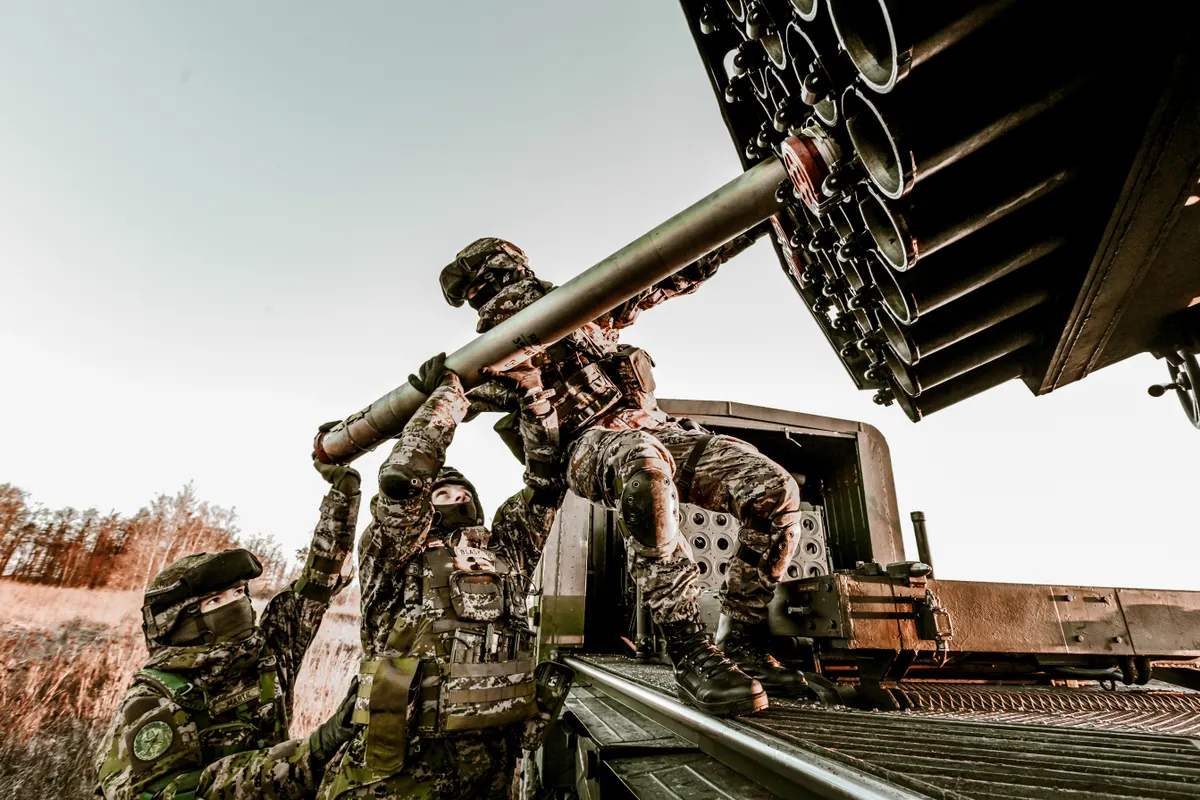
The Larak Island US strike, in which American forces destroyed two Iranian rocket launchers on Sunday, has set off a fresh exchange of hostilities in the seven-month-old war, with Iran retaliating by attacking two American bases in Jordan on Monday and President Donald Trump vowing that Tehran would be hit ‘hard’.
The small island sits in the Strait of Hormuz, the waterway that, according to NBC News, carried 20% of the world’s oil before the war began. Iran has used it as a chokepoint, reportedly requiring tanker crews to divert past the island for inspections and, according to BBC News, forcing vessels to pay $2m to cross. Washington’s stated aim in targeting the launchers was to degrade Iran’s capacity to mine those same shipping lanes.
What the Larak Island US strike was intended to achieve
The US military said the Iranian launchers on Larak Island had been positioned to fire rockets carrying sea mines into the Hormuz Strait. Three people were reportedly killed in the American attack. Iran’s counter-strikes on US bases in Jordan followed within 24 hours, marking the first time the two sides had traded blows in over a month.
Analysts do not read the operation as a change in overall US strategy. ‘By hitting the launchers rather than broader Iranian military infrastructure, the US appears to be punishing a specific behaviour rather than, at least for now, broadening its war aims,’ said Ali Vaez, deputy program director at International Crisis Group.
Jason Brodsky, policy director of United Against Nuclear Iran, put it more bluntly: ‘It is enforcing the blockade.’ Brodsky added that the Trump administration’s goal was to further degrade Tehran’s ability to mine the strait, while keeping the focus on economic pressure as the midterm elections approach.
Economic squeeze and the oil market reaction
Washington has tightened what it calls ‘secondary sanctions’ to punish countries and businesses that buy Iranian crude. US Treasury Secretary Scott Bessent said on Monday, speaking on the sidelines of the Group of 20 finance ministers’ gathering, that Iran was ‘lashing out kinetically’ because the sanctions were already damaging its economy.
The oil market responded sharply. International benchmark Brent crude surged past $90 a barrel on renewed hostilities, last trading at $91.08 on Tuesday. US West Texas Intermediate futures added less than 1% to $86.65 per barrel.
The conflict’s roots stretch back to late February, when American and Israeli forces launched a sweeping assault on Iran, killing its supreme leader, Ayatollah Ali Khamenei, according to NBC News. Since then both sides have sought to avoid an outright return to full-scale conventional warfare, while repeatedly testing where the other’s red lines lie.
One consequence of that sustained pressure has been a gradual erosion of Iran’s ability to blockade the strait. Britannica reports that in late August the US military announced it had cleared all mines laid by Iran in the international shipping lanes of the Strait of Hormuz, removing one of Tehran’s most disruptive tools. Iran’s apparent shift to rocket-launched mines, which prompted the Larak Island US strike, may reflect that loss of capability.
Trump signals further action
Speaking from the Oval Office on Monday, Trump said Iran’s financial systems, armed forces, and governing body had largely degraded, though he added: ‘It doesn’t mean we won’t smack them to see what happens.’ Asked about Iran’s attacks on US military bases in the region, he told Fox News simply: ‘We are going to hit them hard,’ and that ‘there will be a response.’
Neither government appears to want full-scale war to resume. Both, however, have signalled they will answer any further strike. Brodsky described the situation as ‘fundamentally an endurance contest’, warning that Trump’s ‘unpredictability’ should concern Tehran, and that Iran may lash out more aggressively as the economic pressure continues to build.
With Brent crude holding above $90 and the Trump administration pressing ahead with secondary sanctions, the next flashpoint in the Strait of Hormuz may hinge on whether Iran seeks to reassert control over Larak Island or redirects its pressure elsewhere along the route.