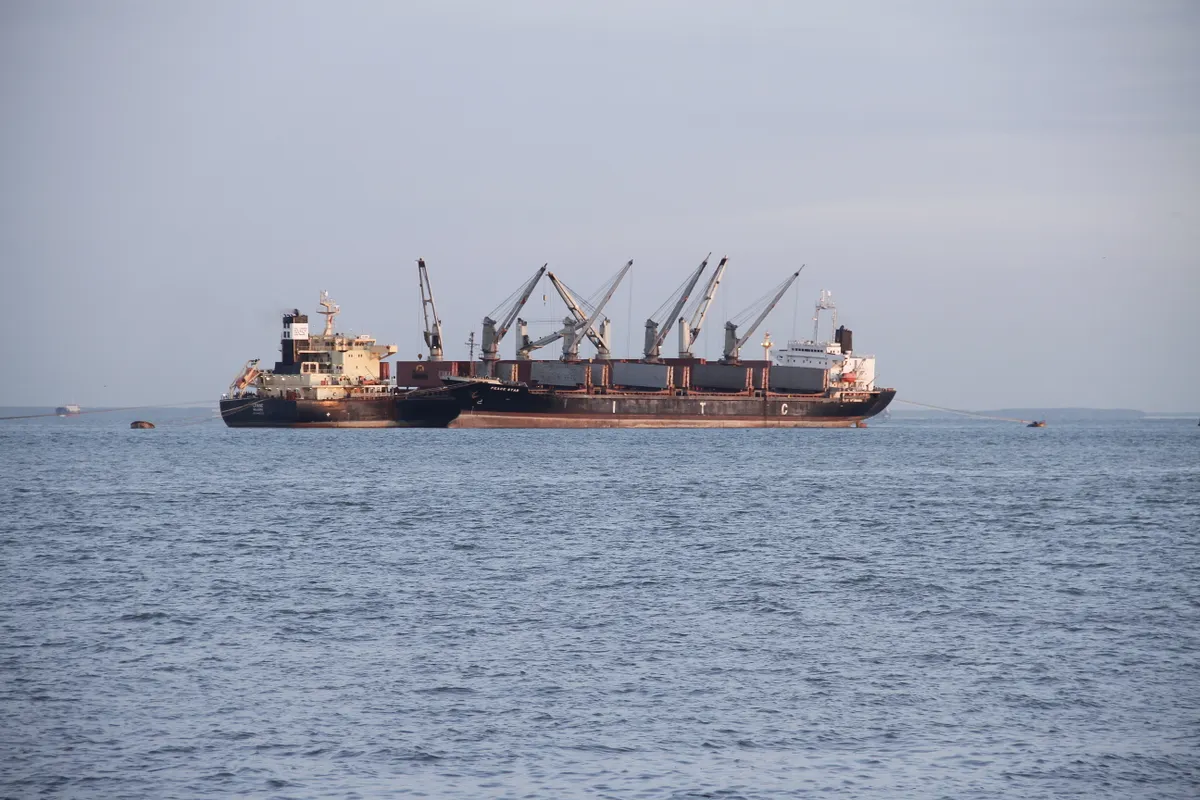
A vessel was hit by an unknown projectile during a Strait of Hormuz vessel strike late on Saturday, the United Kingdom Maritime Trade Operations (UKMTO) centre confirmed, as a senior Iranian official declared further negotiations with the United States pointless.
UKMTO said it received the initial report at 2300GMT on Saturday, according to Anadolu Agency. A fire broke out on board, and local authorities arrived to help evacuate crew members. The vessel had been transiting the Strait when the projectile hit.
What We Know About the Strait of Hormuz Vessel Strike
The attack is one of numerous incidents on shipping in the Strait of Hormuz in recent weeks. The waterway separates Iran and Oman and is a critical passage for oil and other cargo. Shipments through it have slowed to a trickle since the United States and Israel began their war on Iran on 28 February, with ships and seafarers stranded for weeks or months at a time.
The scale of the disruption is stark. Daily vessel crossings in the Strait of Hormuz are now in the single digits, Al Jazeera reported, down from more than 130 a day before the war began. The Saturday strike adds to that picture of near-paralysis in one of the world’s most important shipping lanes.
A separate incident, reported by the Syrian Arab News Agency, also illustrated the risks crews are navigating: on 21 September, a vessel’s fire was extinguished, it continued its voyage, and all crew members were reported safe after a similar episode.
Iran Shuts Door on US Diplomacy
Against this backdrop, any diplomatic off-ramp appears distant. ‘No negotiations. Until Iran’s terms are met, talks are futile,’ said Ebrahim Azizi, head of the Iranian parliament’s national security committee, in a post on X.
A senior Iranian government official and Gulf diplomat told MS NOW that officials from Iran and Gulf countries are due to meet in Oman’s capital, Muscat, on Monday to sign an agreement establishing an Iran-Oman shipping route through the Strait of Hormuz. The same official added that no negotiations with the US are currently taking place.
At the BRICS Summit in New Delhi on Friday, Iranian President Masoud Pezeshkian said Iran would not surrender. ‘Iran has successfully stood against Israel and the U.S.,’ he said. ‘Since we are seeking truth and justice, we will not yield in front of bullying arrogance.’
Pezeshkian’s comments followed US President Donald Trump’s assertion that Iran would have ‘wiped out’ Israel and the Middle East, and begun attacking US cities, had Washington not taken military action. ‘If I had it to do again, I would do exactly what I did,’ Trump said on Thursday.
Blockade, Tankers and Oil Prices
US Central Command (CENTCOM) said on Wednesday it destroyed 10 Iranian tankers the preceding week. On Saturday, CENTCOM added that its forces have redirected 100 commercial vessels over the past 60 days since it resumed a naval blockade against Iran. ‘ZERO ships have passed through the blockade without U.S. forces allowing,’ CENTCOM said in a post on X.
The disruption has fed directly into energy markets. Oil prices pulled back on Friday but still posted sharp weekly gains after Brent crude, the global benchmark, soared above $100 a barrel for the first time in months. Brent crude futures settled down 2.8% at $104.61 a barrel on Friday; US West Texas Intermediate (WTI) settled down 2.4% at $100.05 per barrel. Brent had peaked at around $108 a barrel on Thursday, while WTI hit more than $104.
Saudi Arabia had been routing crude through its East-West pipeline to sidestep the Strait entirely, but the kingdom said on Friday it had shut that facility down as a precautionary measure. The Saudi government said drones launched from Iraq struck the pipeline in the Riyadh and Medina regions on Thursday morning, causing fires, some damage, and injuries.
Trump said on Saturday he expects the war in Iran to end shortly after November’s midterm elections, and predicted oil prices would ‘come tumbling down’ when that happens, speaking on a trip to Ireland.