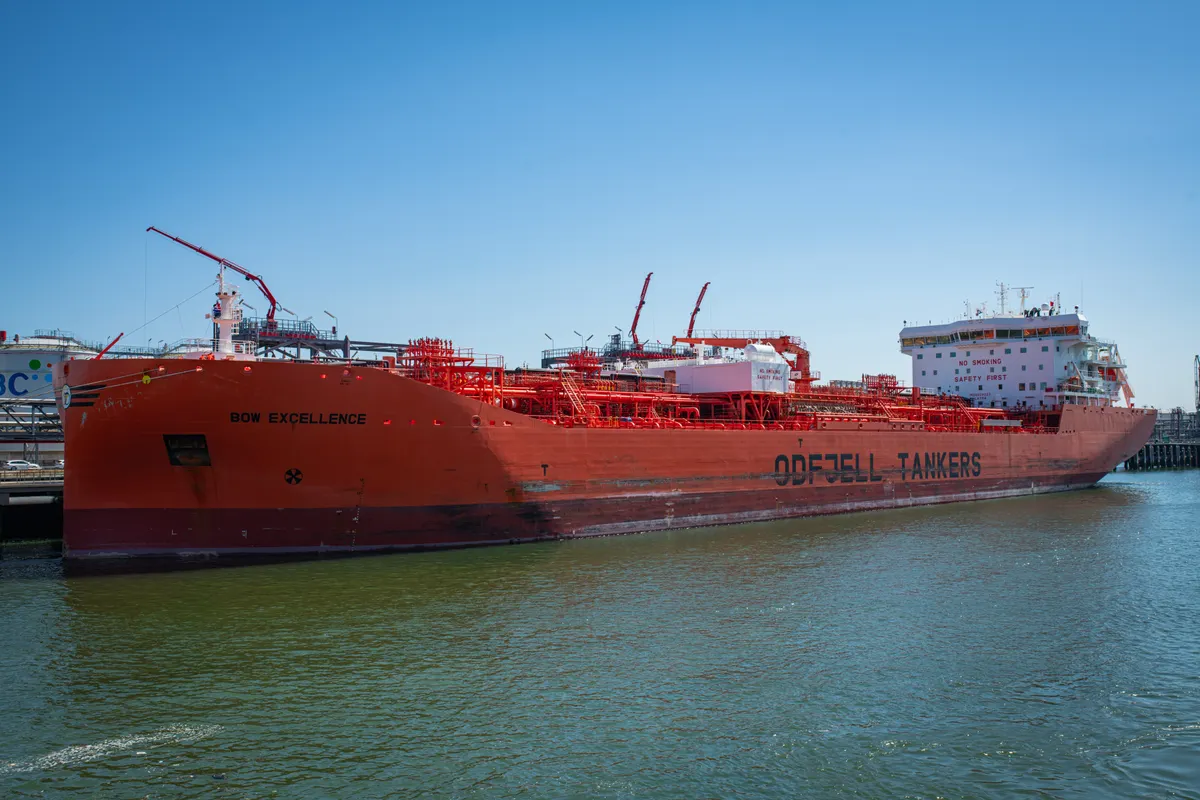
Oil markets rose sharply on Friday as the Iran naval blockade oil prices story intensified, with Brent crude climbing 1.8% to $88.64 per barrel after U.S. officials said an American naval blockade of Iranian ports could continue indefinitely, raising fresh fears about energy flows through the Strait of Hormuz.
The Strait of Hormuz is one of the world’s most critical shipping passages, through which a large share of global oil exports travel. Any prolonged disruption there tends to send crude markets into sharp moves, and Friday’s session was no exception.
U.S. West Texas Intermediate (WTI) crude futures also climbed, rising 2% to $82.89 per barrel. Both benchmarks had dipped around 2% in Thursday’s session but remain on course for weekly gains of around 4% following a sustained rally.
Bessent and Hegseth Raise the Stakes
The latest upward move followed remarks by U.S. Treasury Secretary Scott Bessent, who warned in an interview with Newsmax of measures aimed at the ‘economic isolation’ of Iran which ‘have never been seen’. His comments came after U.S. Defense Secretary Pete Hegseth told reporters that U.S. forces could maintain an indefinite blockade of Iranian ports.
The warnings also follow a claim by the United Arab Emirates that Iran attacked two vessels belonging to the state-owned Abu Dhabi National Oil Company while they were transiting the strait. That incident, disclosed on Thursday evening, added a further layer of tension to an already volatile situation.
Thursday’s session had seen prices retreat after Energy Secretary Chris Wright claimed that oil exports passing through the strait are now higher than many independent estimates, offering the market brief reassurance before Friday’s fresh escalation.
Iran Naval Blockade Oil Prices: The Supply Stakes
The scale of the potential supply shock is considerable. According to Wikipedia’s account of the blockade, an analyst from the Foundation for the Defense of Democracies estimates the blockade is costing Iran $400 million in lost revenue every day. Beyond the financial toll, the same analysis warns that Iranian oil wells face the risk of permanent damage or destruction due to overflow if the blockade is not lifted by 26 April, as wells that are shut in too long can suffer irreversible harm.
On the question of how much crude could ultimately leave the market, the picture is stark. The Brookings Institution has assessed that a total blockade of Iranian oil would remove two million barrels per day from global supply, though it characterised the resulting price increase from that factor alone as ‘moderate’. Separately, energy analyst Hamidreza Shokouhi told Al Jazeera that the U.S. siege means at least 1.5 million barrels per day of Iranian oil exports will be taken off the market.
The gap between Shokouhi’s figure and the Brookings ceiling reflects genuine uncertainty about how completely the blockade is being enforced, and how much Iranian crude is reaching buyers through alternative routes. Either way, the volumes involved are large enough to matter to global markets.
Demand Outlook Darkens as Growth Forecasts Slip
The supply-side pressure is arriving at a difficult moment for the broader global economy. The International Energy Agency said on Wednesday that global oil demand is now expected to fall further than it had previously forecast this year, a projection shaped in part by the disruption around the strait.
The International Monetary Fund has added to the gloomy backdrop. According to CNBC, the IMF on Tuesday cut its global growth forecast for 2026 to 3.1%, down from 3.3% in its January projection, while warning that the world was drifting toward an ‘adverse scenario’ in which oil prices could remain around $100 per barrel. A sustained period of $100 oil would squeeze household budgets and business costs across importing nations, compounding the drag on growth.
With U.S. officials giving no indication of when or whether the blockade might be eased, and Iran naval blockade oil price volatility already running well above normal levels for the week, traders and policymakers alike face the prospect that $100 crude could shift from a worst-case warning to a working assumption. The IMF’s 26 April well-damage deadline, flagged by the Foundation for the Defense of Democracies analyst, gives the standoff a concrete near-term date to watch.